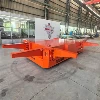
The characteristics of trackless transfer vehicles mainly include the following aspects:
High flexibility: Trackless transfer vehicles are not restricted by fixed tracks, can travel and turn freely in various complex road conditions and environments, and have strong adaptability .
Strong load-bearing capacity: The four-wheel drive design is adopted, which can carry a large weight of items and meet various material transportation needs .
Easy to operate: It is usually equipped with a simple and easy-to-understand control system, and the operator can get started after simple training, and is equipped with easy-to-operate control devices, such as handheld remote controls or foot switches .
Energy saving and environmental protection: The electric drive technology is adopted, no fuel is required, which reduces pollution to the environment, and at the same time reduces energy consumption and maintenance costs .
Versatility: The structural design can be adjusted according to needs to meet the transportation needs of different scenarios, and is suitable for factories, warehouses, logistics centers and other places .
High safety: Equipped with safety functions such as emergency stop buttons and anti-slip devices to reduce the risk of human operation and ensure safety during transportation .
Intelligent: Some trackless transfer vehicles are equipped with auxiliary devices such as positioning devices, clamping devices, lifting platforms, etc. to achieve fully automated control and improve transportation efficiency.
Application areas: Trackless transfer vehicles are widely used in factory workshops, warehouses, logistics centers, construction sites, farmland operations and other places, especially for frequent, short-distance heavy object handling tasks