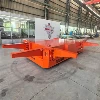
Whether industrial transfer vehicles need doors depends mainly on their purpose and design requirements.
Situations where doors are needed Sealing requirements: Some industrial transfer vehicles need to maintain the sealing of the compartment during transportation to prevent leakage or contamination of goods. For example, medical waste transfer vehicles usually do not have side doors, and the rear door adopts a double-layer closed structure and a labyrinth seal to ensure that the compartment is completely closed. Safety and ease of operation: For transfer vehicles that need to operate in specific environments, doors can provide better safety and ease of operation. For example, vehicles with differential locks need to ensure that the vehicle is stopped or driving at a low speed during operation, and doors can provide better protection and operating space. Situations where doors are not needed Open design: Some industrial transfer vehicles are designed to be open, mainly for short-distance transportation or use in specific environments, and doors are not necessary. For example, the AB interlocking fast doors on the transportation lines within some factories are mainly used for isolation and automated operations, and do not require doors. Automated operation: The hard fast rolling shutter door in the automated logistics system is mainly used in conjunction with AGV (automatic guided vehicle) to achieve automatic opening and closing and improve transportation efficiency. This design does not require traditional doors.