For machinery manufacturing and steel industries, in-plant transportation of heavy materials has long been plagued by high rail installation costs, fixed travel routes and insufficient operational flexibility. Featuring trackless operation, in-place rotation and heavy-load structure, the differential-drive battery-powered electric transfer cart is becoming the preferred alternative to traditional rail transfer carts and overhead crane lifting.
From Rails to Wheels: Flexibility Revolution in Heavy-Duty Transport
Conventional heavy material transport relies on pre-laid steel rails, whose routes are hard to modify once installed. Frequent adjustments of production layouts are common in machinery manufacturing. The differential-drive battery transfer cart completely removes this constraint.
Its core lies in the dual-wheel differential drive system: the left and right drive wheels are controlled by separate motors. Steering is realized by adjusting the speed difference between the two drive wheels, with front and rear caster wheels for follow-up support. This mechanical structure enables forward, backward and lateral turning without an extra steering mechanism. It can even rotate 360 degrees on the spot with a theoretical zero turning radius. For steel workshops with narrow aisles and dense equipment, the transfer cart can travel freely in limited space beneath overhead crane rails instead of being confined to fixed tracks.
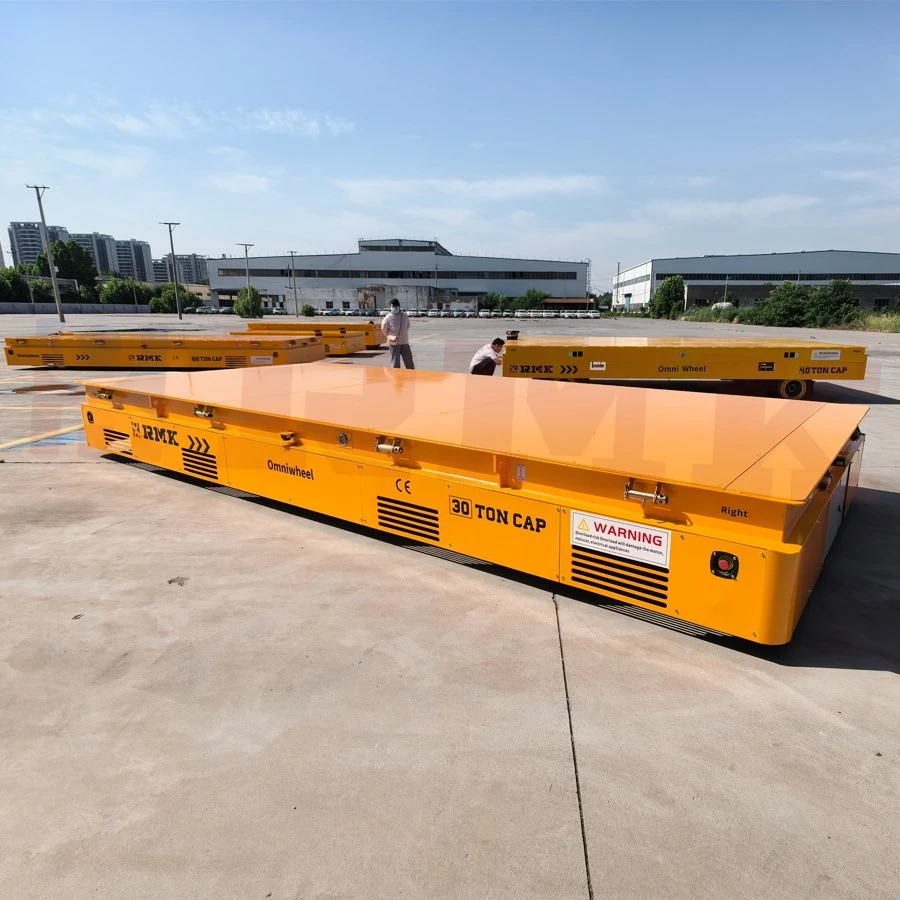
Load Capacity & Structure: Design Logic for Heavy Loads
Load grades of 10t, 20t, 30t, 40t and 50t require precise load calculation. The transfer cart frame adopts box beam welded construction assembled by longitudinal and cross beams. The platform steel plate thickness reaches 12–18 mm, made of Q235B or equivalent national standard steel. Solid wheels with polyurethane coating are applied, with diameters ranging from 350 mm to 550 mm. They disperse ground pressure to protect concrete floors and deliver good wear resistance against metal debris in steel workshops.
For steel coils, the typical cargo in steel mills, the cart platform can be equipped with an embedded V-groove with pre-drilled holes. Removable supports can be fitted to secure steel coils during transport; the supports can be removed for flat loading of steel plates. This dual-purpose design saves investment in redundant equipment.
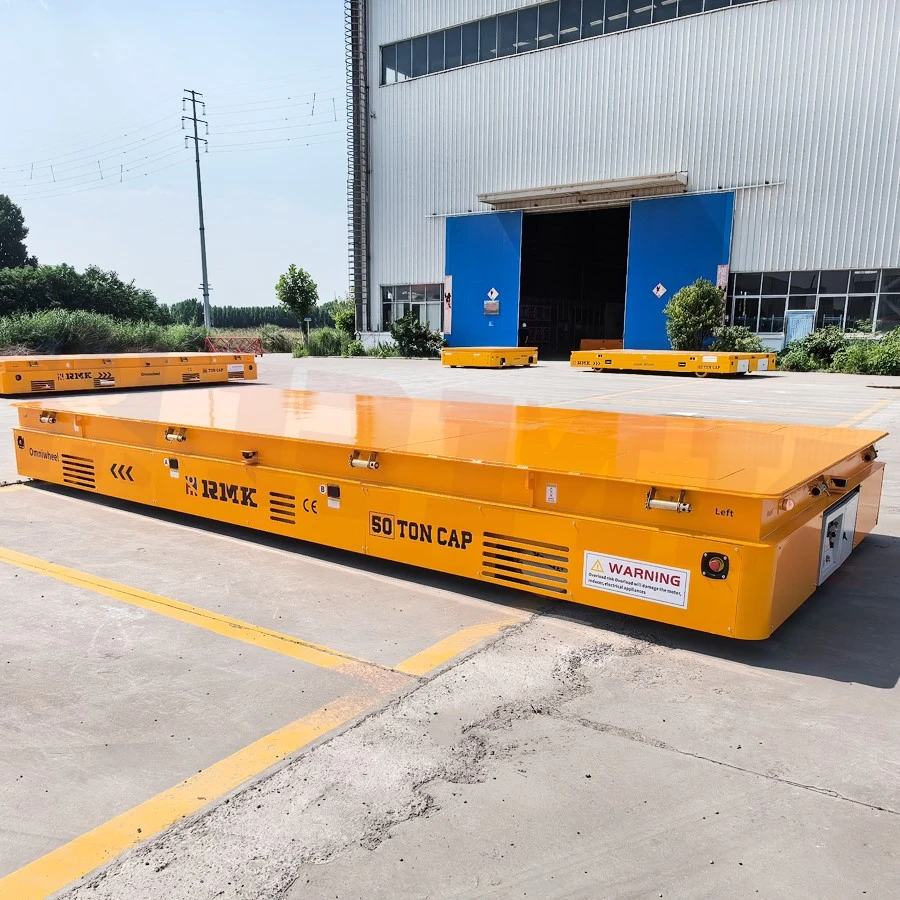
Power & Endurance: Engineering Trade-offs for Battery-Driven Systems
Power source selection directly defines the application scope of the transfer cart. For heavy load electric transfer carts, three options are available: lead-acid battery, lithium battery and supercapacitor.
Lead-acid battery: lowest procurement cost, yet requiring regular maintenance and long charging time.
Lithium battery: compact size and high energy density. Large-capacity configurations support hours of full-load operation with a 6–8 hour charging cycle, suitable for multi-shift continuous production.
Supercapacitor: fully charged within 30 minutes but limited energy storage, ideal for short-distance high-frequency shuttle transport.
Heavy duty Battery tranfer cart Travelling speed is adjustable from 0 to 25 m/min. It runs stably at low speed under full load and can speed up for quick return when empty. Heavy-duty versions are equipped with dual motors of ≥4 kW to handle regular workshop slopes of 5%. For special requirements, motors can be upgraded to 7.5 kW to conquer ramps of around 7 degrees.
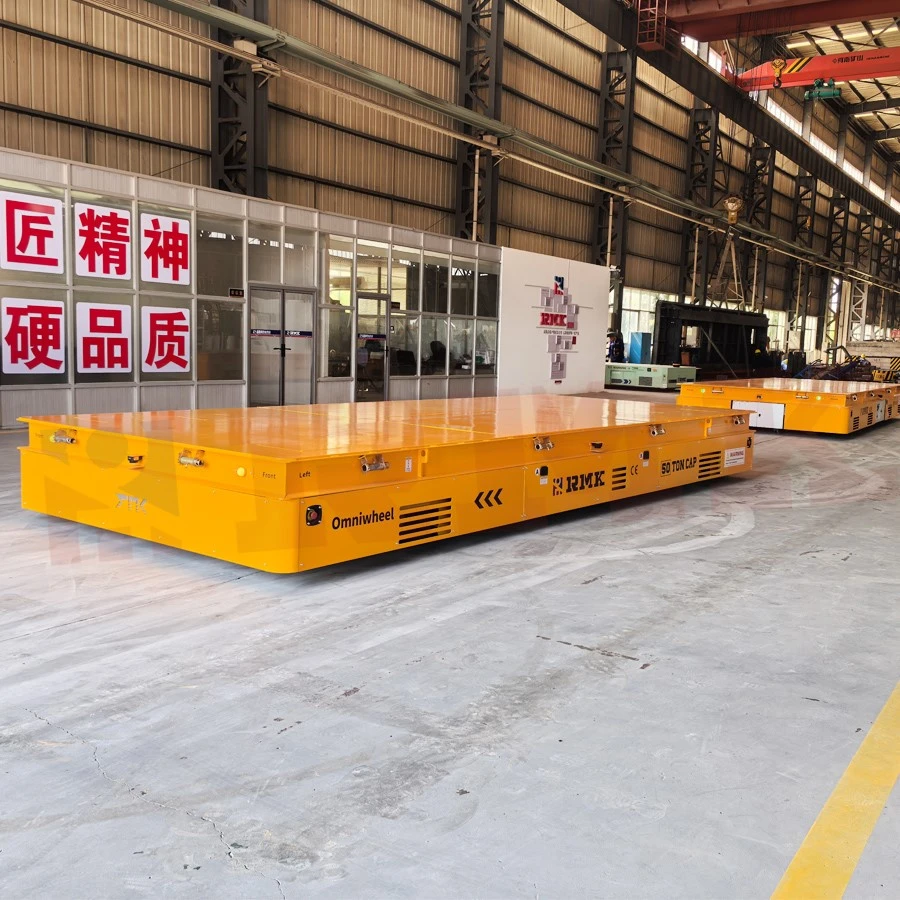
Industry Adaptation: Scenario Differences between Machinery and Steel Sectors
Workshops for machinery manufacturing mainly handle large moulds, castings and assembly components with irregular shapes and high risks of gravity offset. Thanks to independent motor control via differential drive, the cart maintains straight-line travel under eccentric load conditions and reduces deviation caused by uneven resistance on either side. The wireless remote control works up to200- 400 meters, allowing operators to perform high-precision positioning from a safe zone.
Steel industry environments are harsher. Steel coils, steel billets and work rolls feature heavy unit weight and high surface temperature. Explosion-proof requirements are needed for some processes. The transfer cart supports customized high-temperature resistance and explosion-proof design with upgraded IP ratings for the electrical system. The electromagnetic brake automatically engages upon power loss to prevent cart sliding on slopes or material runaway during sudden power cuts.
Safety Redundancy: Essential Configuration for Heavy-Load Applications
Failure of heavy cargo handling leads to far more severe consequences compared with light-duty equipment. The standard safety package includes: laser obstacle detection for automatic stop when obstacles are detected; travel resumes once obstacles are cleared; audible & visual alarms to warn surrounding personnel; electromagnetic brake serving both service and parking brake; multi-protection of the electrical system against undervoltage, overcurrent, overload and short circuit. For some models, hydraulic brakes are added as redundant backup for electromagnetic brakes to guarantee braking reliability downhill.
The value of Remarkable heavy-duty differential-drive battery transfer carts does not lie in outstanding individual parameters, but in the balanced performance of flexibility, load capacity and operating cost. The trackless design eliminates sunk costs of fixed rails; differential steering solves passage challenges in narrow spaces; battery power grants freedom for workshop layout rearrangement. For machinery and steel industries, this is not merely an upgrade of handling equipment, but an engineering cornerstone for production line transformation - shifting from "materials adapt to tracks" to "tracks adapt to materials".