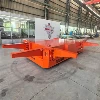
There are many types of transfer vehicles, mainly divided into manual transfer vehicles, electric transfer vehicles, hydraulic lift transfer vehicles and special transfer vehicles. Each model has its specific usage scenarios and technical parameters.
Manual transfer vehicles
Manual transfer vehicles are suitable for short-distance, light-load material handling. For example, the manual transfer vehicle model MT-100 has a size of 1000×500×850 mm, a load capacity of 100 kg, and is made of steel and polyurethane wheels.
Electric transfer vehicles
Electric transfer vehicles are powered by electricity and are suitable for long-distance, medium-load material handling. For example, the electric transfer vehicle model ET-500 has a size of 1500×700×1200 mm, a load capacity of 500 kg, and is equipped with a lithium battery with a range of up to 30 kilometers.
Hydraulic lift transfer vehicles
Hydraulic lift transfer vehicles have a lifting function and are suitable for material handling scenarios that require height adjustment. For example, the hydraulic lifting transfer vehicle model HL-1000 has dimensions of 2000×1000×1800 mm, a load capacity of 1000 kg, a lifting range of 100-1800 mm, and is driven by electric hydraulics.
Special transfer vehicles
Special transfer vehicles are designed for specific scenarios, such as explosion-proof and corrosion-resistant. For example, the special transfer vehicle model ST-EX has dimensions of 1200×600×1000 mm, a load capacity of 200 kg, explosion-proof function, and is suitable for flammable and explosive places.
The selection of these transfer vehicle models and specifications should be determined according to actual needs and usage scenarios to ensure efficient, safe and convenient material handling.