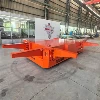
The working principle of rail transfer vehicle mainly includes the following aspects:
Electric transmission system: Rail transfer vehicles usually use electric transmission system, including motor, drive wheel and transmission device. The motor provides power, and the drive wheel is connected to the motor through the transmission device, thereby transmitting power to the wheel axle of the rail transfer vehicle.
Track system: Rail transfer vehicles use rails or steel rails as the track for movement. The track system is usually arranged linearly and can be installed on the ground or on the elevated in factories, warehouses, etc. The design and construction of the track must be able to withstand the weight of the transfer vehicle and the heavy objects to ensure safe and stable operation.
Control system: The rail transfer vehicle is equipped with a control system, which can control the movement and handling operation of the transfer vehicle through control devices such as joysticks, foot pedals, buttons or remote controls. The control system usually consists of a main console, an electrical control cabinet and a control circuit.
Handling device: Rail transfer vehicles are usually equipped with various handling devices, such as lifting devices (such as lifting arms, lifting hooks, etc.), traction devices (such as ropes, chains, etc.) and clamps (such as suction cups, clamps, etc.). These devices can be installed and replaced as needed to meet different handling needs.
Automated functions: Some modern rail transfer vehicles are equipped with automated functions, such as automatic navigation systems, automatic collision avoidance systems, and automatic identification systems. These functions enable the transfer vehicle to navigate, avoid collisions, and identify the location and quantity of the items being transported without human intervention.
Safety systems: Rail transfer vehicles are equipped with various safety systems, including braking systems, warning lights, sound alarms, collision protection devices, and emergency stop buttons. These safety systems can cut off power or stop movement in an emergency to ensure the safety of personnel and equipment.